
VBatt / VPH Short Circuit Fix: Complete Dead Phone Repair Guide
A dead phone can feel like a total loss, but in many cases, the real problem is a short in the main power line. In mobile repair language, technicians often talk about VBatt and VPH/VPH line faults when a phone is completely dead and not responding to the power button.
In simple terms, the problem usually sits somewhere on the battery power path or main power rail, and the fix starts with careful testing, not random part removal. Repair references consistently recommend a step-by-step workflow: visual inspection first, then multimeter checks, then controlled DC power supply testing, and finally short-location methods such as heat detection or careful voltage injection.
For Indian repair technicians, this topic matters because dead phone cases come in every day, from water-damaged boards to power IC faults and shorted capacitors. For general users, the key thing to know is this: a “dead phone” does not always mean the motherboard is fully gone. Many no-power cases are repairable when the short is found correctly and fixed cleanly.
What Is a VBatt or VPH Short Circuit?
A VBatt short means the battery power line has developed an abnormal low-resistance path to ground, preventing normal power flow through the motherboard. A VPH short refers to the same problem on the main system power rail generated downstream.
In both cases, the board cannot power on correctly because the power path is drained before it reaches the processor or PMIC.
To diagnose this issue, technicians use multimeter tests, visual inspection, and safe diagnostic techniques to identify short circuits, test power rails, and repair dead phones effectively.
Common causes include:
- Failed SMD capacitors on the power line
- Damaged MOSFET or power path IC
- Water damage and PCB corrosion
- Solder bridges from a previous repair attempt
Signs Your Phone Has a VBatt or VPH Short
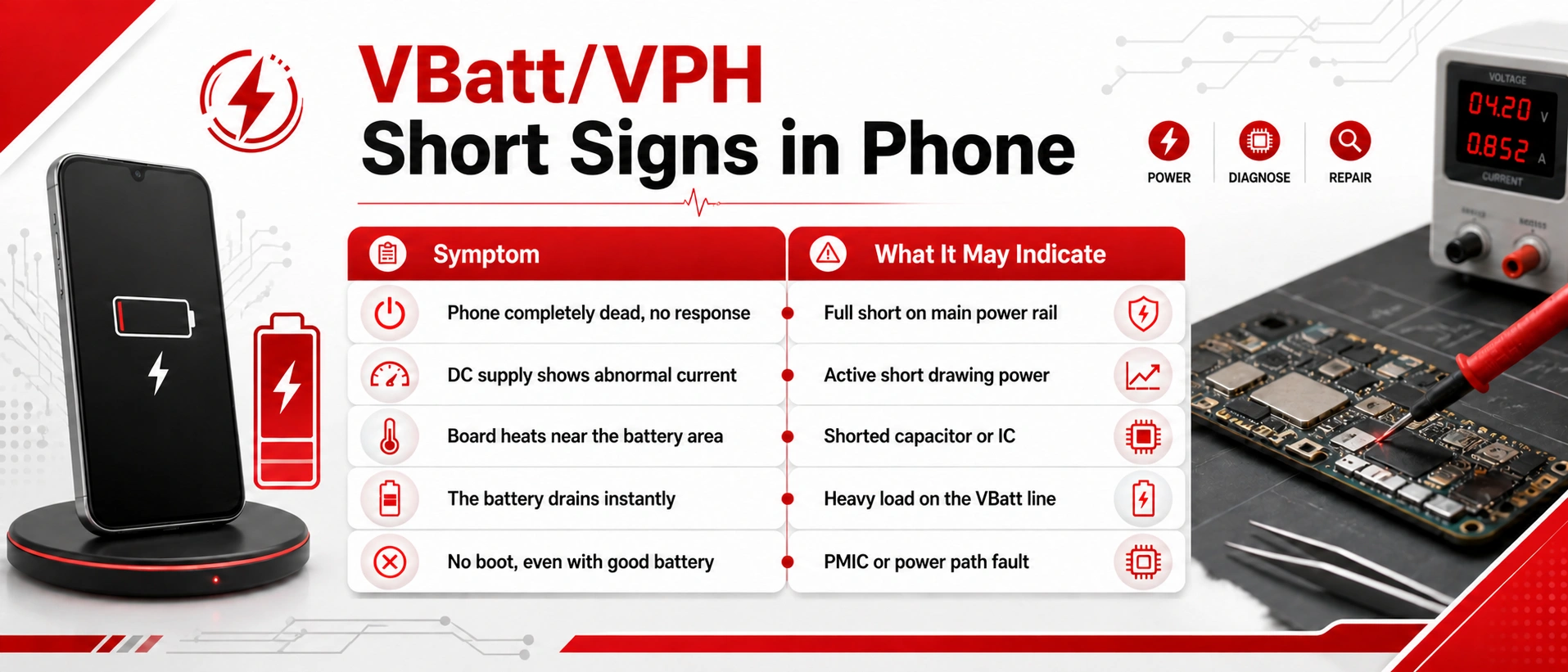
VBatt and VPH short circuits often show similar symptoms, which can make diagnosis confusing. However, by observing these signs, you can understand whether the issue may be in the VBatt line, VPH rail, or both:
- Phone completely dead with no response
This usually indicates a short in VBatt or VPH (or both), as power is not reaching the processor or PMIC. - Battery drains instantly after connecting
This is a strong indication of a VBatt short, but in some cases, a VPH short can also create a heavy load. - DC power supply shows high or abnormal current draw
This symptom is common in both VBatt and VPH shorts, as current is being pulled directly to ground. - Motherboard heats near the battery or power section
Heating suggests a shorted component, which could be on the VBatt line (capacitor issue) or VPH rail (IC/PMIC section). - No boot even with a known good battery
If the VBatt line appears normal but the phone still doesn’t boot, it often points to a VPH short or PMIC-related fault.
Key Takeaway
If you notice these symptoms, there is a high possibility of a short circuit in the VBatt line, VPH rail, or both. Proper multimeter testing is required to confirm the exact fault.
Tools Required Before VBatt/VPH Short Diagnosis
Before beginning VBatt/VPH short circuit diagnosis, ensure you are equipped with the essential tools required for precise and safe testing. Board-level troubleshooting demands accuracy, and using the right equipment allows technicians to efficiently detect short circuits, analyze power rails, and pinpoint faulty components.
A well-prepared toolkit not only saves time but also reduces the risk of damaging the motherboard during diagnosis. Here are the must-have tools for every mobile repair technician.
- Digital Multimeter (continuity + resistance + diode mode)
- DC Regulated Power Supply
- Hot air rework station
- Microscope or magnifier
- Isopropyl alcohol (99%) + soft ESD brush
- Boardview / schematic for the phone model
- Tweezers, soldering iron, flux
How to Fix VBatt / VPH Short in a Dead Phone: Step-by-Step

Repairing a phone for VBatt / VPH Shorting is a technical process. But before opting for a repair, one must confirm the exact reason behind the dead phone. If the issue is confirmed to be due to VBatt/VPH, then the repair can be done by simply following the steps mentioned below:
Step 1 — Confirm the Phone Is Genuinely Dead
Test with a known-good battery and charging cable first. Rule out simple faults before opening the board. Open the phone and do an initial visual pass — look for burnt marks, swollen components, corrosion stains, or broken parts near the battery connector and charging section.
Step 2 — Check the Power Line with a Multimeter
Set the multimeter to continuity, diode, or resistance mode and test the suspected power rail to ground. A near-zero reading or hard beep in both directions usually confirms a real short.
Important: Not every low reading is a fault. Some power rails have naturally low resistance by design. Cross-reference with schematic data or known-good board readings before concluding.
Step 3 — Clean the PCB Before Going Deeper
Use isopropyl alcohol and a soft brush to clean the entire board, especially around the battery connector, PMIC area, and charging section. Corrosion or flux residue can sometimes create partial shorts that disappear after a thorough clean.
Step 4 — Apply DC Power Supply and Read the Current
A DC power supply lets you power the board safely and watch current behaviour. Set voltage appropriate to the phone's battery spec (typically 3.7–4.2V for single-cell Android). Do not blindly apply one setting to all devices — dual-cell phones and newer flagship boards behave differently.
What current behaviour tells you:
- 0.00A — No connection, wrong polarity, or open path
- High current immediately — Full short or heavy load fault is active
- Fluctuating current — Boot sequence issue or power path problem
Step 5 — Locate the Hot Component
Once the DC supply confirms a live short, the goal is to find which component is generating heat first. Methods include:
- Careful touch check (with phone off after brief power-on)
- IPA drop method — isopropyl drops placed on the board; the one that evaporates first indicates the hot spot
- Freeze spray method
- Thermal camera if available
In most VBatt short cases, a capacitor near the PMIC or battery connector heats up first.
Step 6 — Isolate and Remove the Faulty Component
Test capacitors and other components in the suspect area one at a time. If you find a shorted capacitor, remove it carefully and immediately re-test the power line. If the short disappears, you have found the root fault. Replace the component with the correct value if required by the circuit design.
Step 7 — Trace Deeper If the Short Persists
If removing one component does not clear the short, do not start replacing parts randomly. The short on the main rail may actually be coming from a downstream-generated rail — the real source may be further along the power path. This is where model-specific boardview and schematic reading becomes essential.
Step 8 — Final Retest and Power Sequence Check
After the faulty component is removed or replaced:
- Confirm short to ground is gone or significantly reduced
- DC supply current returns to normal pattern
- Board no longer overheats in the affected area
- Phone responds to power button
- Charging and boot sequence work correctly
Clean the board with IPA, inspect all solder joints under magnification, and do a full functional test before reassembly.
Best Practices for Safe and Smart Repair
Work in sequence — random component removal without diagnosis creates new faults. Use model-specific schematics whenever possible, as rail resistance values vary by design. Never exceed recommended voltage or current during short-finding procedures. Always re-inspect for corrosion under shields and around connectors, even on boards that appear visually clean.
When to Visit a Professional Technician
If you are not trained in board-level repair, do not attempt to heat or probe a shorted motherboard with improvised tools. A capacitor short that can be fixed in 20 minutes by a trained technician can become an irreversible CPU or PMIC failure if approached incorrectly.
Conclusion
A VBatt / VPH shorting solution is never just about removing random parts. The right way to handle a dead phone repair is to diagnose the fault in order: inspect the board, test the line, power it carefully, find the hot component, isolate the real fault, and then retest the full power sequence. That is the approach that saves time, parts, and customer trust.
If you are a technician, this step-by-step method will help you solve dead phone and no-power cases more confidently. If you are a phone user, the main takeaway is simple: a dead phone is not always a dead motherboard. Many shorting cases can be repaired when handled by someone who knows the board properly.
Frequently Asked Questions (FAQs)
A VBatt short means the battery power line is shorted or loaded abnormally, which can stop the board from powering correctly. Short circuits are often caused by failed capacitors, MOSFETs, corrosion, or solder issues.
In repair practice, VPH usually refers to the main power rail used in the phone’s power path. If that line is shorted, the phone may stay fully dead or draw abnormal current.
Yes, many dead phone cases are repairable if the short is traced correctly and the damaged component is replaced. Common repair workflows focus on inspection, multimeter testing, DC supply testing, and heat detection.
Small capacitors near the battery connector, PMIC, or charging section are common suspects, though the actual fault can also be a power IC, corrosion spot, or solder bridge.
Not always. Some rails naturally show low resistance, so you should compare readings carefully and confirm with boardview, diode values, or controlled power testing.
A DC power supply helps technicians power the board safely and observe current draw, which makes it easier to spot shorts, open paths, and abnormal power behaviour.